
Over the coming years, we’ll dive into topics such as governing the energy transition with policy insights from across the region, renewable and smart energy systems, energy communities and local-level cooperation, financing and implementation of transition actions, and practical tools like our Easy Energy Blueprints for municipalities and SMEs – plus much more, from digital energy management to public sector planning.
Curious to follow along? Join our Knowledge Community to stay updated and be the first to know once registration opens.
Please find below the link to the registration form to join the EnTRA Knowledge Community:
Your participation in the Knowledge Community is free of charge and flexible – members can join and leave at any time by contacting us via email at oliwia.kaniak@euwt-novum.eu.
Upcoming webinars:
Upcoming webinars will be announced here.
Past webinars of the series.
Find the recaps of all webinars that have taken place so far, along with links to their full recordings.
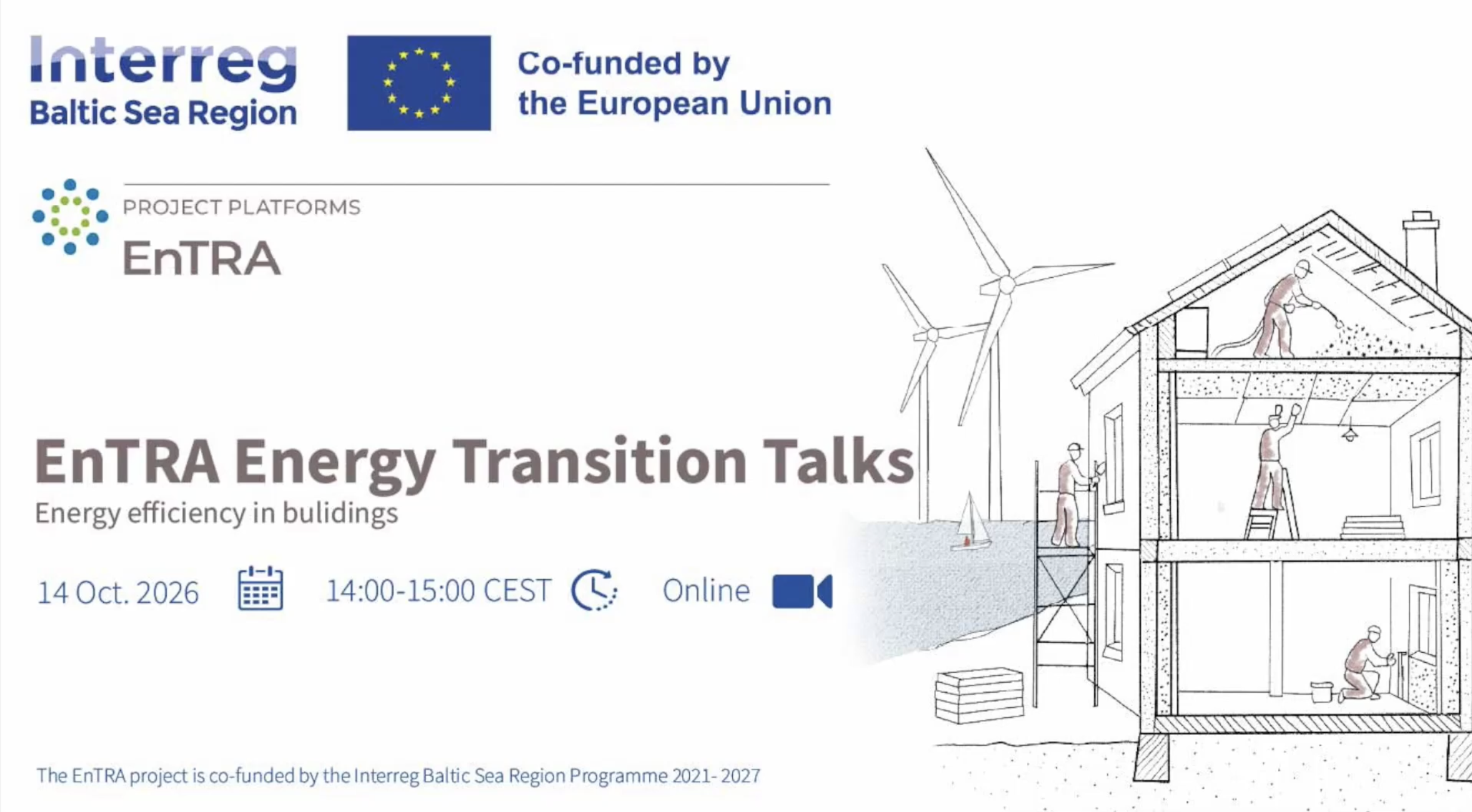
Takeaways from the #2 EnTRA Energy Transition Talks: Practical paths to energy-efficient buildings
VIEW THE FULL RECORDING OF THE 2ND WEBINAR HERE.
On 14 October 2026, the second EnTRA Energy Transition Talk explored practical ways to improve building energy efficiency. Experts from the Tartu Regional Energy Agency and the Renowave project in Võru shared insights into renovation measures, digital tools and approaches that help building owners make informed decisions.
Understanding why building energy efficiency matters
Annika Urbas from the Tartu Regional Energy Agency highlighted the importance of energy efficiency in buildings, noting that buildings do not use energy — people do. How we heat, ventilate and use our homes directly affects energy consumption.
In Estonia, households accounted for around 40% of final energy consumption in 2018, compared with an EU average of 25%. Improving building performance can therefore make a significant contribution to reducing energy use and costs.
Key measures include better insulation, efficient ventilation and heat recovery, LED lighting, modern heating systems, energy-efficient windows and energy monitoring. Energy performance certificates can help building owners understand their buildings’ current performance and identify opportunities for improvement.
Digital tools to support better renovation decisions
Marten Saareoks presented digital tools developed to support energy advice and renovation planning. These include Easy Energy Blueprints, a renovation calculator and a tool for assessing the feasibility and sizing of solar photovoltaic systems.
His central message was simple: start with the question, not the tool. Digital solutions can help compare options and understand potential benefits, but they do not replace energy audits, on-site assessments or expert advice. The right approach begins with understanding the building’s needs and selecting tools that support informed decisions.
Link to different Energy Tools: https://www.trea.ee/energy-tools-2026-10/
Renovation requires trust and cooperation
Siim Meeliste shared experiences from the Renowave project in Võru, which supports apartment building renovation through a one-stop-shop approach and cooperation between homeowners.
The project combines information, practical guidance and peer learning. Homeowners can exchange experiences, participate in meetings, access support and explore renovation options together. A renovation dashboard connected to the building register also helps make relevant information more accessible.
The project’s work has contributed to greater awareness of building energy performance: the number of energy performance certificates increased from 69 to 209. The experience illustrates that renovation is not only a technical challenge. Clear information, trusted guidance and cooperation are essential to help communities move from interest to action.
Sharing practical solutions for the energy transition
The second EnTRA Energy Transition Talk showed that improving building energy efficiency requires a combination of technical solutions, accessible digital tools and long-term support for building owners. While each building and community has different needs, practical advice and opportunities to learn from others can make renovation decisions easier and more achievable.
The discussion also reflected the wider aim of the EnTRA project: strengthening cooperation and knowledge-sharing to support the energy transition across the Baltic Sea Region. Through its Energy Transition Talks, Knowledge Community and Coffee Chats, EnTRA continues to connect stakeholders and share approaches that can be applied in practice.
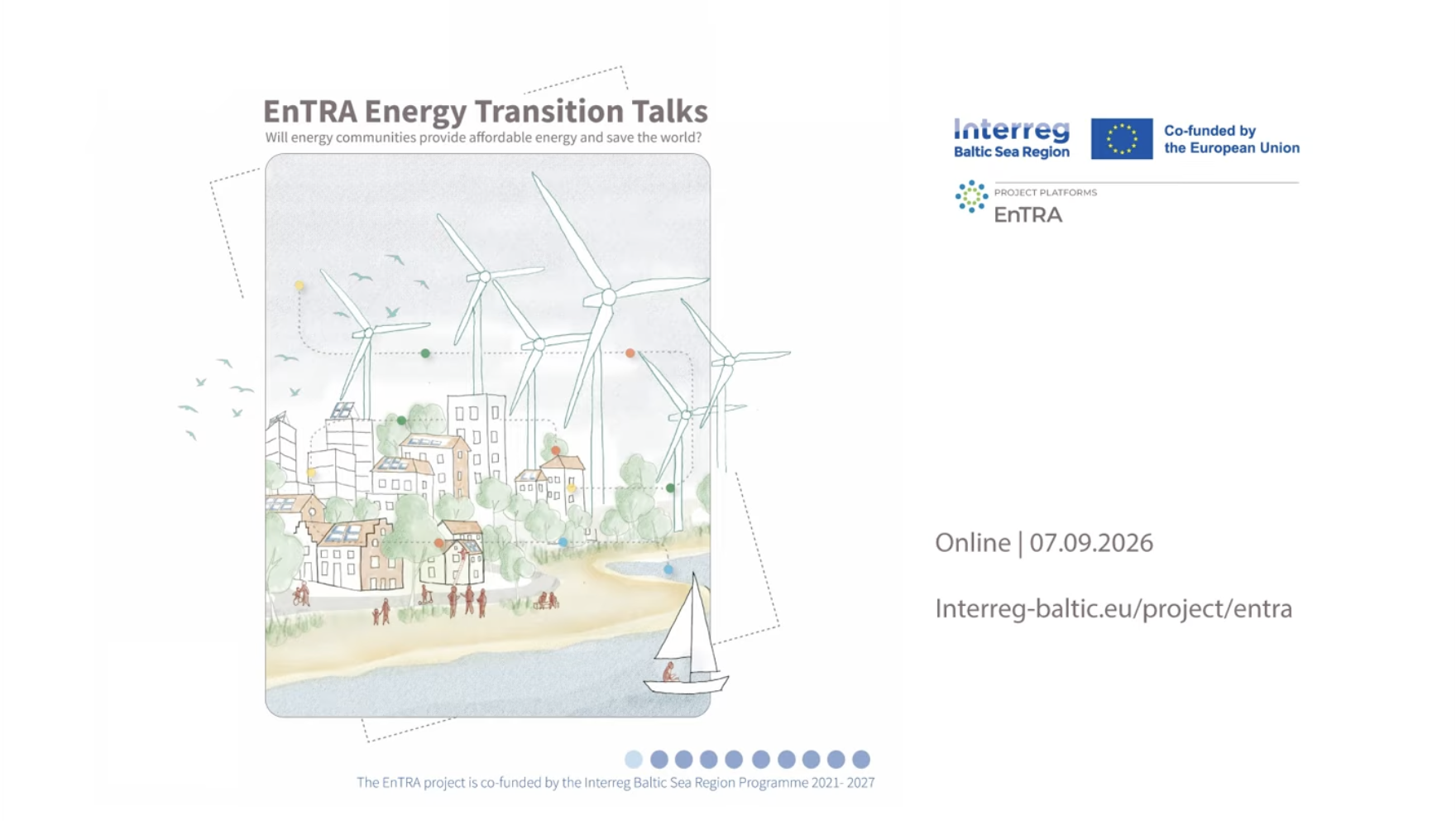 Takeaways from the #1 EnTRA Energy Transition Talks: Energy Communities – From Ambition to Action
VIEW THE FULL RECORDING OF THE 1ST WEBINAR HERE.
The first webinar of the EnTRA Energy Transition Talks series brought together experts from Estonia, Latvia and Poland to discuss the development of energy communities across the Baltic Sea Region. The discussion showed that interest in energy communities is growing, driven by the search for cleaner, more secure and locally controlled energy systems. At the same time, participants highlighted that enthusiasm and investment alone are not enough to make energy communities work in practice.
Different countries, different stages
The panellists presented experiences from three countries at different stages of development.
In Estonia, energy communities are still at an early stage. Awareness and interest have increased, and several communities have already been established, particularly in southern Estonia. However, the lack of a practical energy-sharing framework remains an important barrier.
In Latvia, there is a growing community of practitioners and many emerging initiatives, but significant gaps remain between innovative ideas and the legal, technical and market frameworks needed for their implementation.
Poland has experienced rapid growth in registered energy communities. The discussion highlighted that around 840 communities are now registered, although registration does not necessarily mean that they are already operational. Municipalities are also working to prepare the tools and procedures needed to develop energy communities as the legal framework evolves.
Beyond technology: the importance of people and governance
One of the key messages from the discussion was that establishing an energy community is only the beginning. Communities need people who can manage administration, communicate with members, coordinate activities and ensure the long-term operation of the organisation.
Legal and institutional conditions are equally important. Procurement rules, decision-making procedures and limitations on energy sharing can make cooperation between municipalities, citizens and other actors difficult. The speakers also stressed the growing need for qualified specialists, advisory services and practical support for communities.
Energy security, resilience and stronger communities
The benefits of energy communities go beyond renewable energy production and potential financial savings. Speakers highlighted their contribution to energy security, local resilience and social cooperation.
Energy communities can give residents greater control over part of their local energy system and help maintain essential services during crises. They can also encourage communities to look at their energy system more broadly – from renewable generation to building renovation, heating and storage.
At the same time, the discussion underlined that energy communities are one element of the wider energy transition, rather than a universal solution. Their potential and benefits need to be assessed according to the specific local economic, environmental and social context.
Sharing experience to support the energy transition
The webinar opened a series of ten EnTRA Energy Transition Talks designed to support knowledge exchange between projects and stakeholders working on the energy transition in the Baltic Sea Region.
Through the EnTRA Knowledge Community, participants will have access to webinars, and informal peer-to-peer Coffee Chats. While the webinars will provide practical knowledge and examples of existing solutions, the Coffee Chats will create space for direct exchange of experiences, discussion of challenges and mutual learning between peers. The initiative aims to make existing knowledge and solutions easier to access, reuse and adapt in different contexts.
The first webinar demonstrated the value of bringing together experiences from different countries: while the regulatory and institutional contexts vary, many of the practical challenges are shared. Continued cooperation and exchange of experience can therefore help organisations move from promising ideas towards solutions that can be implemented and sustained in practice.