The idea for the Kääpa energy community emerged through the Smart Villages development programme, where local people, the municipality and energy experts discussed the village’s future needs. The first discussions were followed by meetings in Kääpa with representatives of the Tartu Regional Energy Agency (TREA) and the municipality. Later, an opportunity arose to involve Kääpa as a StartSun pilot area.
At the same time, Kääpa was looking for new energy solutions. The existing boiler house was in very poor condition, the municipality was working on a district heating solution, and apartment buildings needed renovation. Creating an energy community was therefore linked not only to electricity, but also to heating, building renovation, the functioning of local services and greater energy independence.
Why this case matters
In Kääpa, the energy community was driven by several local needs at once. Solutions were needed for heating, building renovation, local services and greater energy independence.
Main challenge
The most difficult task was finding a model that would motivate different stakeholders to join at a time when it was not yet possible to demonstrate a direct financial benefit.
Lesson for others
In a small community, adopting a new energy solution takes time. It requires trusted local leaders, repeated discussions and clear answers to practical questions.
A village looking for practical solutions
The idea of an energy community in Kääpa was not limited to electricity. Finding a better solution for local heating was equally important.
The boiler house is currently operated by a private company, which is planning a more sustainable heating solution. The company intends to replace oil heating with wood chips and renovate the boiler house. The renovation would help make the local heat supply more reliable.
In the future, the boiler house could also produce hot water if the residents of at least one apartment building wanted such a solution. In that case, it could make sense to build a solar park near the boiler house. Since the boiler house has not yet been renovated, building a solar park there was not considered practical at this stage.
The original plan had to change
Initially, the aim was to involve local stakeholders connected to services important for the village, including companies and organisations linked to heating, the local shop and water supply.
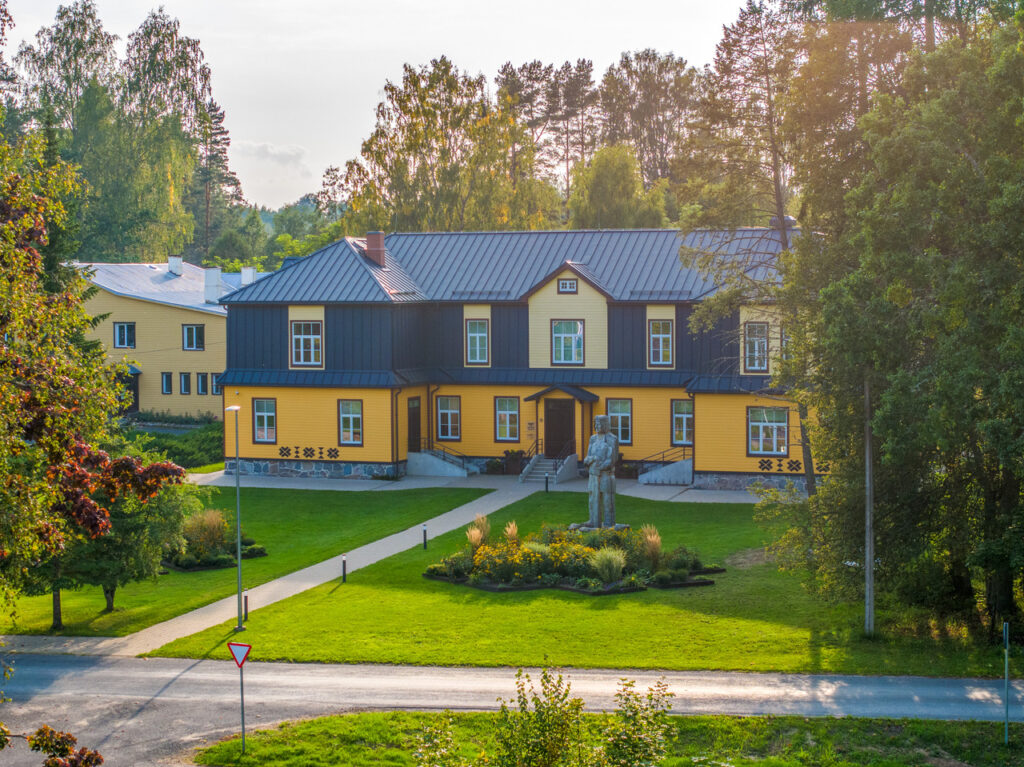
Several obstacles emerged during the process, and the original plan had to be adapted. The buildings now directly involved in the energy community initiative are the community house and the Kalevipoeg Museum, managed by the Kalevipoja Koda Foundation.
Kalevipoja Koda is a project partner and will remain so for another five years. After that, the organisation can continue as a member of the energy community.
The original solution did not prove fully feasible, so new opportunities had to be found. Adjusting the plans therefore became a natural part of the process.
Interest developed step by step
Local entrepreneurs were generally more open to the idea, while some residents were more cautious.
There were few functioning energy communities in Estonia that could have helped explain the new model simply and concretely. People had practical questions. What benefit will the energy community bring? Will others join? Will participation be worthwhile?
Financial concerns caused the greatest hesitation. People feared that joining would require costs without a clear understanding of what they would receive in return. The concept of an energy community itself was also difficult to explain and is still not understood in the same way by everyone.
Experiences from other countries, local discussions and solar park simulations helped people better understand the possible solutions. Interest and willingness to participate developed gradually.
Who should move forward together?
An early question was who should establish the energy community together.
The aim was to make participation possible for both businesses and private individuals. This immediately raised practical questions. On what basis could someone become a member? What decision-making rights would members have? Which legal form would suit the different parties?
Involving private individuals proved difficult. Building solar parks on apartment building roofs was also not considered practical at this stage. The focus therefore shifted more towards businesses and public buildings.
The local electricity grid also imposed limits. The grid connection did not have sufficient capacity to sell electricity to the grid, and increasing that capacity would have required an investment of approximately EUR 30,000.
It was also difficult to find a project manager with enough time to lead the whole process.
Trust matters more than speed
The progress of an energy community depends largely on trust. People will not join an initiative if they do not understand the risks involved or fear that participation could harm them.
Both the potential risks and benefits therefore need to be explained thoroughly. In Kääpa, it was considered better to move more slowly and give people time than to rush ahead and damage trust through mistakes.
Local leaders play an important role. It is easier for people to join a new initiative alongside people they already know and trust. Someone coming from outside the community finds it harder to establish the same kind of connection without an existing relationship.
Flexibility and expert support helped move the process forward
Progress was supported by a willingness to adapt the original plans, expert support from TREA and other project partners, and closer communication with the village’s larger companies.
The discussions increased awareness of the opportunities offered by an energy community, and a cooperative was established whose members want to develop the initiative further.
The next important step is completing the solar parks. They are expected to provide direct benefits to two buildings that are important to the community.
Future ideas discussed include apartment building renovation, the use of hydropower at Koseveski, and dryers for garden and forest products.
There was no ready-made model
Kääpa did not have a ready-made energy community model that could simply be adopted. The solution had to be shaped around local needs, opportunities and constraints.
Based on the experience so far, it would have been useful to invest more time in finding a strong project manager and, from the outset, to study more closely the experiences of Estonian places where similar initiatives had already begun.
In a small community, understanding and adopting a new energy solution takes time. In Kääpa, progress has required trusted local leaders, repeated discussions and a willingness to adjust the original plans. The energy community did not emerge around one ready-made solution. It developed step by step as different needs and opportunities emerged during the process.
Interested to learn more?
Join us on 22 September 2026 for the conference “From Concept to Community: Launching Solar Energy Communities“. This conference brings together local authorities, community initiatives, apartment associations, energy community leaders, developers, researchers, entrepreneurs and others interested in local renewable energy.
The conference will share practical experiences, success stories and challenges from developing solar energy communities, including technical, social and funding-related aspects, as well as cooperation models for turning ideas into action. Participants will also be introduced to the StartSun handbook and energy community feasibility calculator. The conference will be held in English and is co-funded by the European Union.