by Antti Roose, EC4RURAL project manager in the University of Tartu.
Despite Estonia’s climate neutrality ambitions and growing expansion in solar energy, the development of Renewable Energy Communities (RECs) remains slow and fragmented. Although the EU’s policy initiative on energy communities has been partially transposed into Estonian national law, the overall framework is still incomplete and loose. This creates uncertainty for rural actors and limits the deployment of citizen-led small-scale renewable energy initiatives. This synthesis of the EC4RURAL project summarises the main barriers, demonstrates piloting in rural communities, and proposes acceleration measures for RECs in Estonia.
Why RECs matter for rural Estonia?
Community energy has gained momentum across Europe, providing communities and citizens with opportunities to co-generate and prosume energy, strengthen local energy resilience, and support a just energy transition. In Estonia, however, community energy projects remain the exception rather than the rule. The reasons span across legal, technical, economic, and cultural dimensions.
The EC4RURAL project starts from a simple but powerful idea: rural areas across Europe already have what they need to become clean energy champions — space, sunlight, community spirit — yet they often lack the tools and support to turn these resources into real energy solutions. EC4RURAL steps in to bridge that gap. Bringing together partners from Estonia, Spain, and Belgium, the project works directly in villages, small towns, and pilot municipalities to show that the energy transition doesn’t have to come from Brussels. It can start on a school roof, in a village hall, or through a community initiative, and grow outward as people see the benefits and join in.
Rather than pushing a single model, EC4RURAL embraces multiple facilitation models for rurality. Each rural area has its own history, challenges, and opportunities — whether it’s ageing populations, declining local economies, or outdated electricity grids. At the same time, these areas also hold untapped potential: multifunctional rural premises with semi-autonomous electricity supply can host solar energy, supporting rural communities and their residents with more secure and affordable energy. The bottom-up, multi-actor EC4RURAL approach assists communities in co-creating solutions that fit their realities, blending practical small-scale engineering, hands-on pilots provided by the Tartu Regional Energy Agency, and community learning in training modules taught by the University of Tartu.
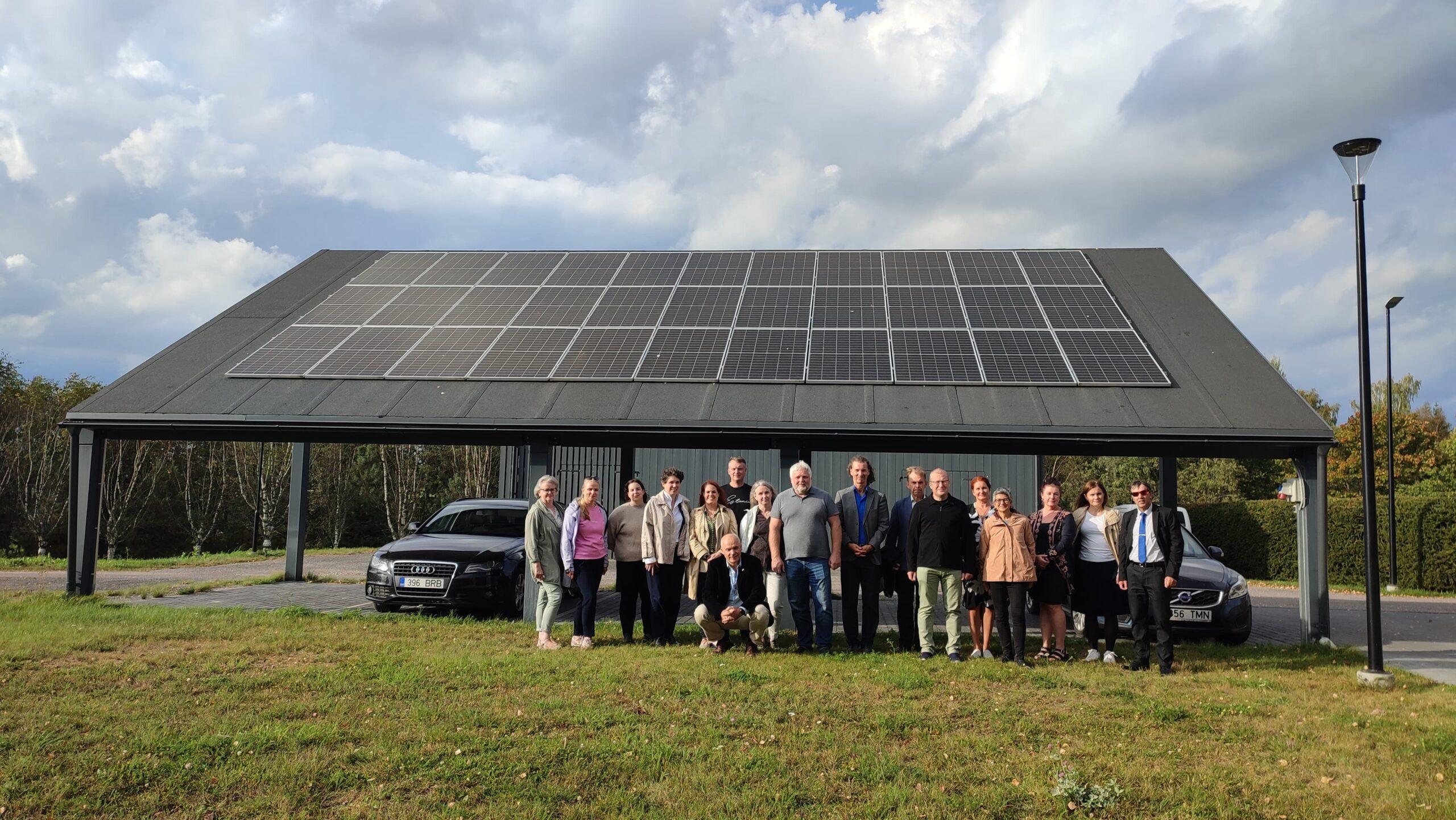
As the pilot work in Estonia shows, installing solar panels on a sports centre or village hall can become a catalyst for local energy resilience and community empowerment with new technologies. By combining piloting and demonstration with policy support and training, EC4RURAL helps rural municipalities move from “we should do something in the energy transition” to concrete action across Estonia in 12 rural communities.
Key barriers in developing energy communities
- Fragmented legal framework
Estonia has transposed some elements of EU directives, such as voluntary participation, but several core principles remain absent or poorly defined. Concepts like effective control, autonomy, and proximity rules are essential for implementing genuine citizen ownership, but are not enforced in current legislation. As a result, the legal environment enables market actors based on the scale of economics while spreading scepticism among rural communities regarding energy innovation in a highly dynamic small energy market. In addition, no public authority has been appointed to support energy communities, leaving active stakeholders without an institutional entry point.
- Grid-related barriers
The national electricity grid is operating near capacity, and connecting new installations can cost much more than the PV facilities themselves. These grid connection costs present a barrier to small-scale rural initiatives. Existing support schemes in energy transition do not prioritise smaller community-led energy investments.
- Weak business case for collective prosumerism
Following the rapid expansion of household solar, the economics have shifted. With volatile Nord Pool prices and the decline of feed-in tariffs, grid generation is much less profitable due to excessive generation during the sunny season. Simple individual installations often outperform collective ones in their economic merits.
- Limited municipal resources
Although community spirit is growing, agreement-based infrastructure projects remain difficult to implement. Municipalities lack resources, model solutions, and technical expertise to act as facilitators. Formal proceedings, public tenders, and other public management complexities weaken the role of local authorities.
Pathways for REC action in Estonia
- Strengthen and clarify legislation
Estonia should fully integrate EU criteria into national law and clearly define acceptable governance models for RECs and CECs. Explicitly incorporating autonomy, community control, and proximity would reduce legal ambiguity and protect community-led initiatives. Establishing a dedicated public authority or expanding an existing one would provide much-needed coordination.
- Empower municipalities as facilitators
Local governments are well positioned to initiate neighbourhood- and village-scale projects for local energy resilience and self-supply, which are also gaining importance due to the risks of hybrid warfare. With technical assistance and ready-to-use legal proceedings and feasibility modelling tools provided by the Tartu Regional Energy Agency and other EC4RURAL partners, municipalities can act as brokers between citizens, grid operators, and funders.
- Develop a national enabling framework
A structured enabling framework should include:
targeted financial support tailored to small and community-led projects, as is the case in many Central and Eastern European countries,
simplified procedures in renewable projects, speeding up permitting, etc.,
tools supporting decision-making, such as an open-source viability calculator linked to grid reservation and funding schemes.
These measures would reduce risks for small actors and stimulate REC growth, especially in rural areas.
- Address rural grid quality
To unlock REC potential outside urban areas — which mainly rely on underground cables — rurality needs prioritising grid upgrades and climate-proof infrastructure that ensures connectivity for small producers. Smart grids, hybrid systems, and energy storage could relieve pressure on the network, while administrative procedures should reflect the realities of sparsely populated regions.
By adopting a coherent enabling framework, addressing grid bottlenecks, empowering municipalities, and aligning national legislation with EU principles, Estonia can create the conditions for a just and community-driven energy transformation in rural areas.